I am science.
Why I see being on a clinical trial as a privilege
In December last year I started a new cancer treatment. I am currently on a clinical trial, taking a drug that is not yet on the market. It is a targeted drug, not chemotherapy, and is so new that it doesn’t even have a name yet. The trial that I am on is what is called Stage One/ Two – which means it is at the very early stages of development, and that means we’re not sure what its impact will be and that I am, literally, science. I see this as a privilege as not everyone gets given these opportunities and I recognise how lucky I am.
I wanted to write something (maybe it will end up being more than one thing) about being on a trial. Before I had Stage 4 cancer I thought of trials as a last resort – drugs that were offered to patients when there were no other options on the table. That’s not true - and I believe it’s important to try to access trial drugs, should you ever be in a position to need them and that that access needs to be equal for all.
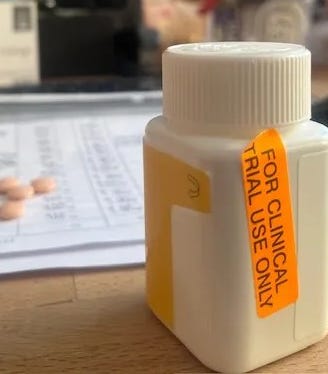
I have stage 4 breast cancer. That means the cancer has spread from the place where it was originally found to other parts of my body. It means that there are tiny cancer cells floating around in my body and the treatment that I’m on (whatever it is) is trying to stop those cells in their tracks, trying to stop them from getting comfortable in more places in my body and trying to shrink the tumours where they already exist. It also means that there are only a limited number of drugs that have been approved to treat the cancer - and each time one fails that means one less option is available to me. Being on a trial gives me another option, and I’m lucky to have it.
I am not cancer. In fact, I make a point of never calling the cancer in my body mine. Cancer has come along as an uninvited guest. It likes my body (who can blame it) and it’s trying to get comfortable there. And our plan, that’s me, my oncologist and my lovely team, is to keep it as uncomfortable as we can for as long as we can.
I am science. Trying a new drug. Trying to outsmart the cancer, trying to remind it who is the boss here. I like to think of being on a trial as being given early access to an exclusive sale. Early access to something potentially wonderful that everyone will want, but only a few people can actually have. The drugs I am taking now will probably take years to get approved and be generally available. So, for me, this clinical trial is the only way to access them.
My oncologist once told me that treating stage 4 cancer is a bit like playing a game of chess. We are constantly trying to surprise the cancer, outsmart it and keep it from growing and spreading. The thing is though that cancer is smart and knows how to eventually out-manoeuvre all the treatments that currently exist. We don’t know how long those treatments will work for, it’s different for everyone. We have no control over that – but we do know that even if we outsmart it time after time for a while there will eventually come a time when it will play the final check mate.
That’s why being science matters.
Because being on a clinical trial gives you access to drugs that the cancer might find it harder to outsmart because it has never come across them before. Yes it’s a gamble and of course we don’t know what will happen. But we do know what will happen if we don’t take that chance. Trials allow us to have skin in the game for longer, to potentially win more moves. And I believe that one day a trial will come along that will be the check mate – the one that will destroy cancer completely.
We’re not there yet. There is no cure. No winning move. But each trial moves us closer to one. That’s why I’ll always advocate to be on trials, to be a scientist. Being science is a privilege and if I can help others like me in the future it’s something that I really want to do.
I am grateful. To the hospital I go to (Barts), to the team who take such good care of me, to the oncologists who suggested this trial to me (and explained it so clearly) and to science and the scientists and people who are way smarter than me, people who have brilliant ideas about how we can stop cancer in its tracks. So many people make trials happen, they organise never ending appointments, take bloods and observe me, watch carefully to see what is happening and are always thinking about how we can make things better - not just for me but to those who come after me, those who might never have to have the harshest of treatments that so many of us have to endure now.
I am hopeful. When I was first diagnosed I remember sitting with my oncologist and asking if there would ever be a drug that could target just the cancer and not the rest of our beautiful bodies too. I remember saying that there must be a better way than chemotherapy – that we must try to find something. And now I am playing my part in finding that something – a targeted drug that might possibly do that. That’s less than 4 years after I asked the question in the first place. Science is amazing.
Fourteen-year-old me would be laughing. The little girl who grew up in a family of medics, surrounded by science and determined to study the arts. No physics or chemistry for me, instead my head was in a book, my hands were holding pencils. Today, that not so little girl finds herself fascinated by the biology of cells, researching the possibilities that new drugs can provide and getting her head around the science of medical oncology.
I am science. I am lucky. I am hopeful.
I have stage 4 cancer.
More than one thing can be true at once.
Hi Juliet,
Another exquisite and candid piece from you - absorbing and moving reading.
I am here, twenty years after my blood cancer, because of trials.
There was the “spin to win” one at the start that determined which chemotherapy regime I’d be on for the next six months. I got the standard, incredibly harsh one for that time, rather than the gentler Spanish protocol that is now not just widely used and saving countless lives, but transforming how APML patients exist during the treatment. I was also in one of the first patient cohorts to automatically receive ATRA - the silver bullet treatment for APML people that takes us into an initial remission.
Then during my third cycle, alongside the constant chemo (for that cycle I was on a constant chemo drip for six days, no break), I had the luck to also be a trial patient on MiloTarg - which does have a massively long official name, but all I needed to understand was that it specifically zoomed in on anything that looked like a baddie in my bloodstream.
A year later and well into my remission, I attended a Leukaemia Care day, where I heard from a number of experts and talked to other people who had been through blood cancer or still had it. My heart still breaks when I remember the older man who had not been able to access MiloTarg because of the health trust her was under among other factors, and was facing limited treatment avenues.
Cancer’s not just a game of chance with our bodies and how we respond to treatments, but also in terms of access and suitability.
But we always need to say yes to new trials and treatments. As you said so eloquently, we’re not simply playing the role of a guinea pig. We are science.
I’m sorry you have to be, but thank you for being science x